

Explainable AI for Supply Chain: Why Your System Needs to Show Its Work.
What explainable AI actually means for demand and inventory decisions, why human-in-the-loop depends on it, and how to tell real reasoning from a story told after the fact.
- Explainable AI for supply chain shows the rationale behind a recommendation, not just the number.
- The claim is easy to make. The test is whether the reasoning is built into the model or narrated after the fact.
- Explainability is what makes human-in-the-loop real: a person can only own a call they can question.
- It’s a different tool from an LLM, and it sharply reduces the hallucination risk that comes with general-purpose AI.
- Where it goes deepest is inventory optimization — the safety-stock, replenishment, and DC-sizing calls that tie up working capital.
What does explainable AI for supply chain actually mean?
Explainable AI for supply chain is AI that shows you why it reached a number, not just what the number is. When the forecast moves, you can see which signals moved it; when it flags a stockout, you can trace the reasoning to the data underneath. You get a recommendation you can question, defend, and use to deliver impact.
That sounds obvious. It isn’t how most forecasting works. A lot of supply chain AI is, underneath, very good pattern memorization: it learns from history and projects more of the same, returning a confident figure whether or not the situation still resembles what it learned from. Ask why, and there’s no answer it can give you; the reasoning was never something it kept. That’s the “black box” people complain about. Not that the model is wrong more often, but that when it’s wrong, nothing warns you, and no one can explain it to the person who has to act.
The shift you need to catch usually arrives as a faint demand signal — a customer ordering differently, a region softening — long before it reaches your sales totals. The job is to uncover that signal while it’s still early and to show you what’s happening, so a team member can take action instead of finding out months later. Demand is the visible edge of this. Where we go deepest is inventory optimization: the safety-stock, replenishment, and DC-sizing decisions that commit working capital and are painful to unwind.
A forecast your team can’t explain is a forecast they’ll quietly override — and then you’re paying for a model just to work around it.
What’s the difference between black-box and explainable AI?
The difference isn’t academic. It shows up in three moments a planner actually feels: when conditions shift, when someone overrides the model, and when a CFO, board, or regulator asks why. In each one, a black box leaves you exposed; explainable AI puts the reasoning on the table where a person can use it.
A worked example: a planner presents a number to a room that moved eight percent overnight, with no way to say what drove it. The room doesn’t trust the number, and why should they?
The “asks why” moment is no longer only internal. Under the EU AI Act, transparency obligations begin applying in August 2026, and the Act builds explainability into its definition of transparency (EU AI Act, Art. 13). “The system recommended it” is becoming a compliance gap, not just an awkward meeting.
Why does human-in-the-loop depend on explainability?
Because you cannot keep a human in the loop if they can’t understand the recommendation. Most platforms now define human-in-the-loop as a person supervising an agent that acts. We view it the other way: the person is the decision-maker, and the engine’s job is to give them the reasoning to own the decision.
We keep the person in the seat not because automation is bad, but because the decisions our customers bring us are the kind someone has to answer for: a demand decision that commits a quarter of capacity, a DC you’re about to resize, an account worth growing.
That doesn’t mean a person signs off on everything. Above a confidence threshold your team sets, routine calls just go through — one customer auto-accepts anything the model is sure enough about. It’s the decisions below that line, where the stakes or the uncertainty run higher, that route to a person with the reasoning attached. Automate what’s routine. Show the work on the decisions that decide whether you finish in the red or the black.
Take the explanation away, and the human in the loop is a rubber stamp on a number they can’t see inside. Explainability and human-in-the-loop are the same commitment from two sides.
Is explainable AI the same as an LLM?
No. A large language model is built to produce the most plausible answer — ideal for words, wrong for a number you’ll commit capital to. Ask one for a forecast and it can hand you a confident figure with nothing behind it. Explainability works the opposite way, grounding every output in the structure of your own data.
We use LLMs ourselves, judiciously, for the language work they’re built for: drafting and making sense of long documents. But a forecast is not a sentence. Because explainable AI isn’t generating plausible text in the first place, the hallucination risk that comes with general-purpose AI is greatly reduced — not eliminated, but close. Every output carries its drivers and a confidence range. Different tools, different jobs.
How do you tell real reasoning from a story told after the fact?
Ask any vendor one question, because “explainable” is now on everyone’s site: is the explanation how the model reaches its answer or a summary generated afterward? A story laid over a decision the model made some other way may read well but be wrong about the model it describes, because explanation and decision came from different places.
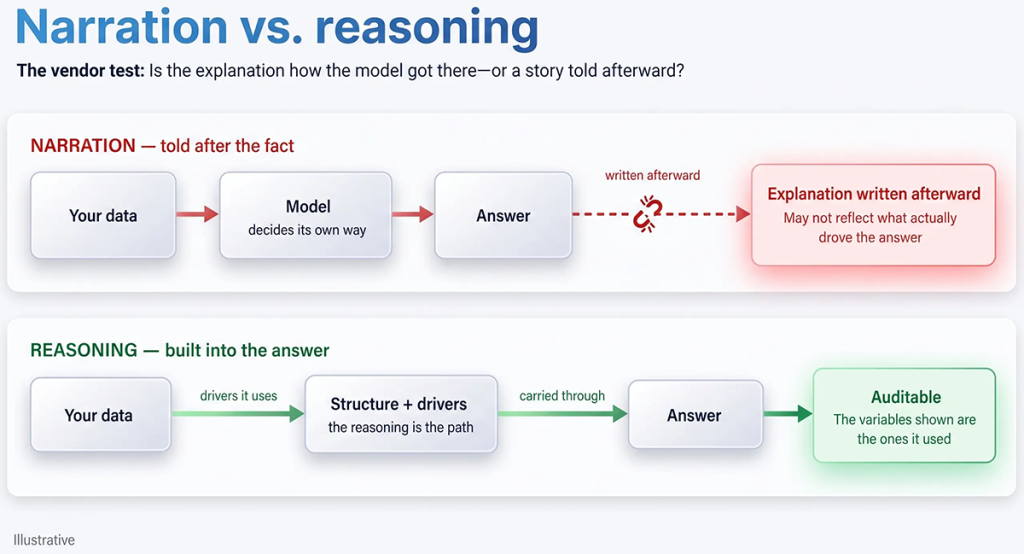
Real reasoning is different. When the system tells you demand moved, the variables it shows you are the ones it actually used. There’s nothing to reconstruct after the fact, because the explanation isn’t a second step. That’s the line between an explanation you can audit and a description written to reassure you.
Our engine (Deep Topological Modeling) sits in the second camp. It reads the shape and structure of your data rather than its surface patterns, and the drivers it exposes are the ones it carried to the answer. See how the Engine works →
Does the same Engine work on data that looks nothing alike?
Here’s a fair test of whether explainability is fundamental to a method or bolted on: point the engine at problems that look nothing like sales or inventory history and see if it still works. Explainability that’s built into the method translates well across operational challenges.
The same engine we use to forecast demand and optimize inventory for distributors and manufacturers has found the process variables behind why a distillery’s batches kept moving out of spec. Pointed at a university’s records, it flagged which students were sliding toward withdrawal while there was still a semester to reach them. And in REACT-X, an active Ohio research project, it is applied to battlefield casualty triage and medical logistics, where a wrong decision is measured in lives. Different data, one engine. That breadth is how we know the depth is real, and the depth is why the reasoning holds.
Where does explainable AI work, and where doesn’t it?
Explainable AI of this kind works best where there’s genuine structure to find: demand, inventory dynamics, processes, behavior — anything driven by real underlying forces. It isn’t magic on data that’s truly random, and it won’t manufacture a signal that isn’t there. It needs history to learn the structure, though much less than pure pattern-learners need.
It’s strongest exactly where conventional models are weakest: long horizons, changing conditions, and decisions someone has to defend out loud — which describes most high-stakes inventory and demand calls. If your problem looks like that, explainability isn’t a luxury. It’s the difference between a number your team executes on and one they nod at and set aside.
Frequently asked questions.
Quick answers on explainable AI, human-in-the-loop decisions, and how to tell real reasoning from a story told after the fact.
Still have questions?Talk to us→What’s the difference between black-box and explainable AI?
Does explainable AI mean human-in-the-loop?
How can I tell if a vendor’s AI is genuinely explainable?
How does explainable AI improve inventory optimization?
Got a projection nobody can explain?
We do this work with distributors and manufacturers, and we go deepest on inventory optimization. Bring us one decision you’re trying to make and twelve months of history. We’ll tell you what we find and why we found it.