

Item Master Data Integrity: The Tax on Forecasting, Inventory, and Deals.
What item master data integrity actually means, how duplicate and incomplete records can drain procurement, inventory, forecasting, and M&A synergies, and how to fix the records that matter without cleaning everything.
What is item master data integrity, and why does it make or break operations, analytics, and deals?
Item master data integrity is the degree to which every product, part, or SKU exists once, is described consistently, and can be trusted across every system that uses it. When it is high, procurement, inventory, forecasting, and finance all read the same reality. When it is low, each function quietly works from its own version, and the errors compound downstream.
- Item master data integrity means one item, one record, described the same way everywhere: not a data-lake problem, a decision problem.
- Bad item data leaks money through six functions at once: procurement, inventory, forecasting, finance, commerce, and compliance.
- In M&A, two unreconciled item masters are where projected synergies quietly disappear.
- You should not try to clean all of it. Govern the records that touch money-decisions and let the long tail stay messy.
What is item master data integrity?
Item master data integrity is the condition where every item exists once, carries complete and standardized attributes, and reconciles across every system it touches: ERP, planning, procurement, and commerce. It is measured by uniqueness, completeness, consistency, and accuracy. High integrity means one item equals one trustworthy record everywhere.
The failure is mundane and expensive. The same bolt is entered three times as “HEX BOLT M8,” “Bolt, hex, 8mm,” and “M8 HEXBLT,” each with a different unit of measure and a different preferred supplier. Now procurement buys it three ways, inventory counts it in three places, and any forecast or AI model built on top treats one part as three. Nobody decided to do this. It accumulated, one hurried record at a time.
What does bad item master data actually cost?
More than most leaders think, because the cost hides inside other budgets. Gartner estimates poor data quality costs the average organization $12.9 million a year. On item and material master specifically, Electronic Commerce Code Management Association’s 2025 analysis finds 25–30% of records are duplicates, and that most companies cannot positively verify the identity of up to 25% of their suppliers.
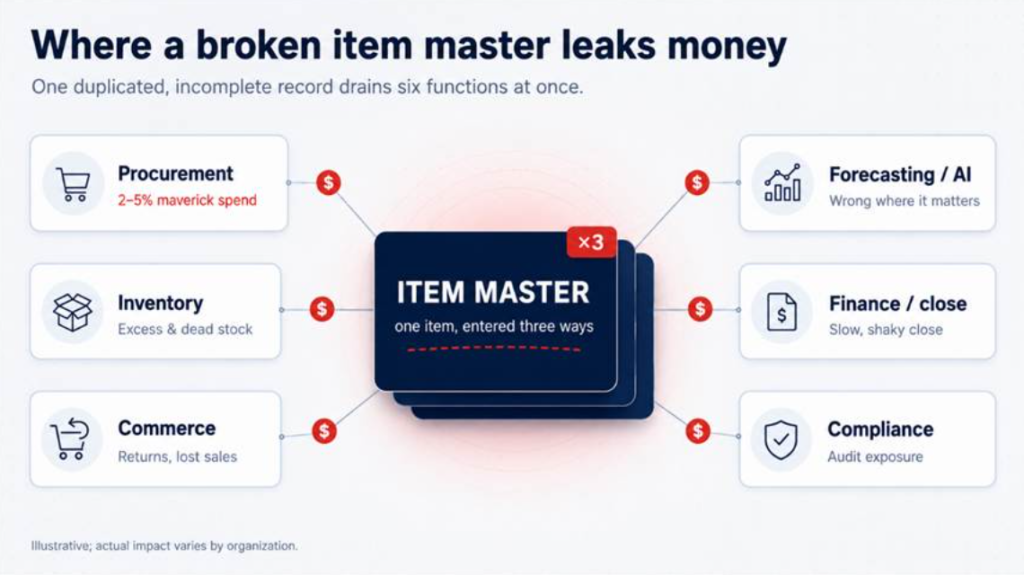
It does not leak from one place. It leaks from six at once:
| Function | How a broken item master leaks money | Signal to watch |
|---|---|---|
| Procurement | Duplicate and substitutable items bought separately at worse prices | 2–5% maverick spend / leakage |
| Inventory | Excess safety stock and dead stock against phantom availability | Carrying cost, write-offs |
| Forecasting / AI | The model learns a fiction and is wrong at the decision level | Forecast overrides, low adoption |
| Finance / close | Reconciliation breaks; the books take longer to trust | Slow close, restatements |
| Commercial / eCommerce | Wrong specs and attributes drive returns and abandoned carts | Return rate, conversion |
| Compliance | No clean lineage to audit or trace | Audit findings, exposure |
How does a broken item master break forecasting and AI?
An AI model is only as trustworthy as the item master beneath it. If one item exists as three records, the model splits its demand history across them and under-forecasts each record. If units of measure are inconsistent, the model may compare demand recorded in individual units with demand recorded in cases without a reliable conversion, creating misleading SKU-level forecasts.
The result can look accurate in aggregate but fail exactly where a planner needs to act: at the item-location level. The model has not discovered the truth; it has faithfully reproduced the mess in the data.
This is why master data is usually the lowest-risk, highest-return first move toward AI readiness. Cleaning the item master delivers value you can see — fewer duplicate buys and tighter inventory — before you bet anything on a model. Skip it, and every downstream analytics or AI initiative inherits the same fiction and slowly stalls.
Clean the item master first. Half of what looks like an “AI problem” is a data problem in disguise.
Why does item master data decide whether a merger hits its synergies?
Because most deal synergies are priced on combining two operations that describe their items differently. KPMG’s 2025 M&A research finds most deals fall short of their projected synergies, with integration execution — not strategy — the usual cause (KPMG, 2025). Until the two item masters reconcile, that combined value cannot even be measured.
The mechanics are concrete. Two companies each have an item master. Overlap them and you get duplicate parts under different numbers, conflicting units, and supplier records that will not reconcile. Until that is resolved, you cannot see true combined spend, rationalize suppliers, consolidate inventory, or shut down a redundant ERP, which is where the synergy case lives.
An acquirer models $40M in procurement synergy from combining two distributors. Nine months in, the savings have not landed: the same 6,000 SKUs exist under two numbering schemes, so “combined volume” per supplier cannot be proven, and negotiations stall. The synergy was real. The item master was not ready to capture it. (Illustrative composite, not a specific deal.)
How good is your item master? The five levels of integrity.
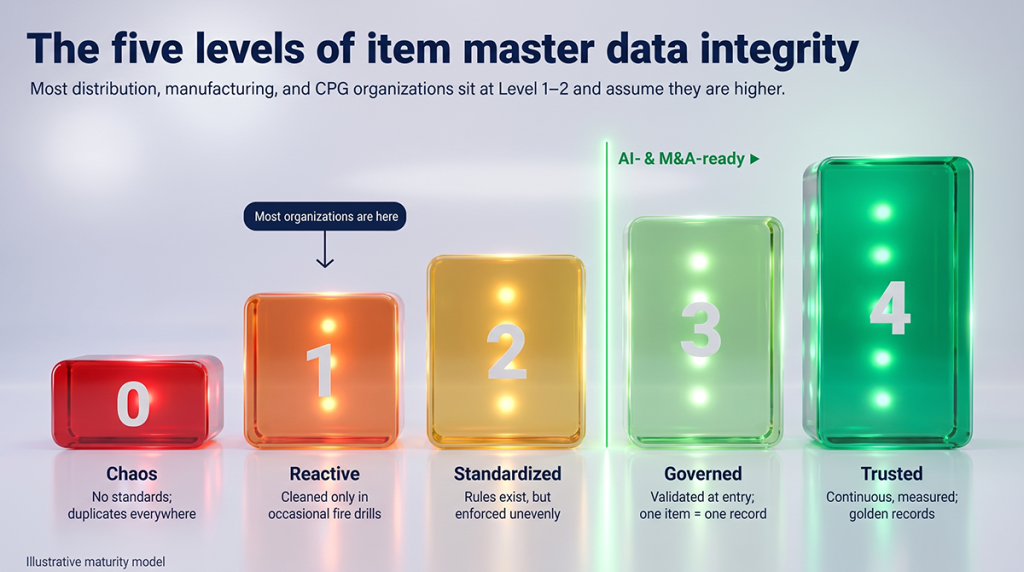
Item master data integrity moves through five levels, from ungoverned chaos to a continuously trusted, M&A-ready record. Most distribution, manufacturing, and CPG organizations sit at Level 1 or 2 and assume they are higher. Find your level honestly; the jump that matters is from reactive cleanup (Level 1–2) to governed-at-entry (Level 3).
| Level | Name | What it looks like | Can you run AI / a merger on it? |
|---|---|---|---|
| 0 | Chaos | No standards; every team names items its own way; duplicates everywhere | Not effectively |
| 1 | Reactive | Cleaned in occasional fire drills; no owner; quality decays between cleanups | Not effectively |
| 2 | Standardized | Naming conventions and required attributes exist but are enforced inconsistently | Barely |
| 3 | Governed | One owner; validation at entry; deduplication monitored; one item = one record | Yes, for core records |
| 4 | Trusted | Automated validation; golden records; quality measured and reported continuously | Yes, and M&A-ready |
Should you try to clean all of it?
No — and trying is why most master-data programs fail. Teams launch a “clean everything” initiative, spend a year on records nobody makes decisions from, exhaust the budget and the goodwill, and quality decays again before the work finishes. Perfect data across a million long-tail SKUs is not the goal and never pays back.
Govern the records that touch money-decisions: your highest-spend items, fastest movers, most-substituted parts, and anything a forecast, a supplier negotiation, or a deal model depends on. That is usually a small share of records carrying most of the value. Clean and govern those to Level 3 or higher, monitor them, and let the long tail stay imperfect until it earns attention.
A master-data program that treats every record as equally important is a master-data program that will not finish.
How do you improve item master data integrity?
Fix it as a governed process, not a one-time cleanup, and sequence it so value shows up early. The goal is one trustworthy record per item at entry, for the records that matter, with monitoring that keeps it that way.
Scope to money-decisions.
Identify the records that drive spend, inventory, forecasts, and any active deal. Start there, not with the full catalog.
Set the standard.
Define naming conventions, required attributes, and units of measure. Adopt a recognized standard (e.g., ISO 8000) so the rules are defensible and portable.
Deduplicate and enrich.
Merge duplicates into golden records; fill missing attributes; verify supplier identities.
Validate at entry, with human decision rights.
Put the rules where records are created so new duplicates and invalid records cannot form. Automate routine checks, but route exceptions and ambiguous matches to an accountable data steward or business owner. The system flags and recommends; the human decides. This is the shift from Level 2 to Level 3.
Assign an owner and measure.
Name an accountable data owner, and report uniqueness, completeness, consistency, and accuracy on a schedule.
Done in this order, cleanup pays for the governance: fewer duplicate buys and less dead stock fund the program before it reaches the long tail.
How product data intelligence tools clean and match item data at scale?
Product data intelligence tools automate the classification, deduplication, and matching that manual master-data work cannot keep pace with. They turn messy, incomplete item descriptions — common in industrial, wholesale, MRO, and distribution catalogs — into clean, hierarchical, matchable records that downstream forecasting, search, pricing, and sales enablement can trust.
Three capabilities do most of the work:
| Capability | What it does | What it unlocks |
|---|---|---|
| Classify to a taxonomy | Maps unstructured item data — descriptions, manufacturer info, item numbers — into a consistent product taxonomy, returning a confidence score and similar matches | Reliable search, forecasting, and pricing on standardized items |
| Find internal near-duplicates | Applies the same matching engine to your own catalog to surface similar or near-duplicate items | Consolidation of redundant SKUs and cleaner spend (the fix in sections 06–07) |
| Match to competitor items | Cross-references your inventory against competitor items, and vice versa, from available competitor data | Assortment gaps, price benchmarking, and provable combined volume in M&A |
One principle matters more than any single vendor: insist the tool returns a confidence score and its similar matches, so a person can verify a reclassification or a merge instead of accepting it blindly. Item decisions should stay reviewable, not opaque. Mined XAI delivers a suite of these tools; the capability is what earns trust.
Frequently asked questions.
Quick answers on item master data integrity, deduplication, and what it means for M&A.
Still have questions?Talk to us→Why do duplicate item records matter?
What does item master data have to do with M&A?
How do you measure item master data quality?
How do you fix item master data without boiling the ocean?
Talk to us
We do this work with distributors, manufacturers, CPG brands, and acquirers integrating a new business because the item master is where their forecasting, inventory, and synergy cases either hold up or eventually fall apart. If your teams are arguing about which number is right, or a deal model is resting on two catalogs that don’t reconcile, bring us the data. We’ll let you know what your risk exposure looks like and what you can do about it.